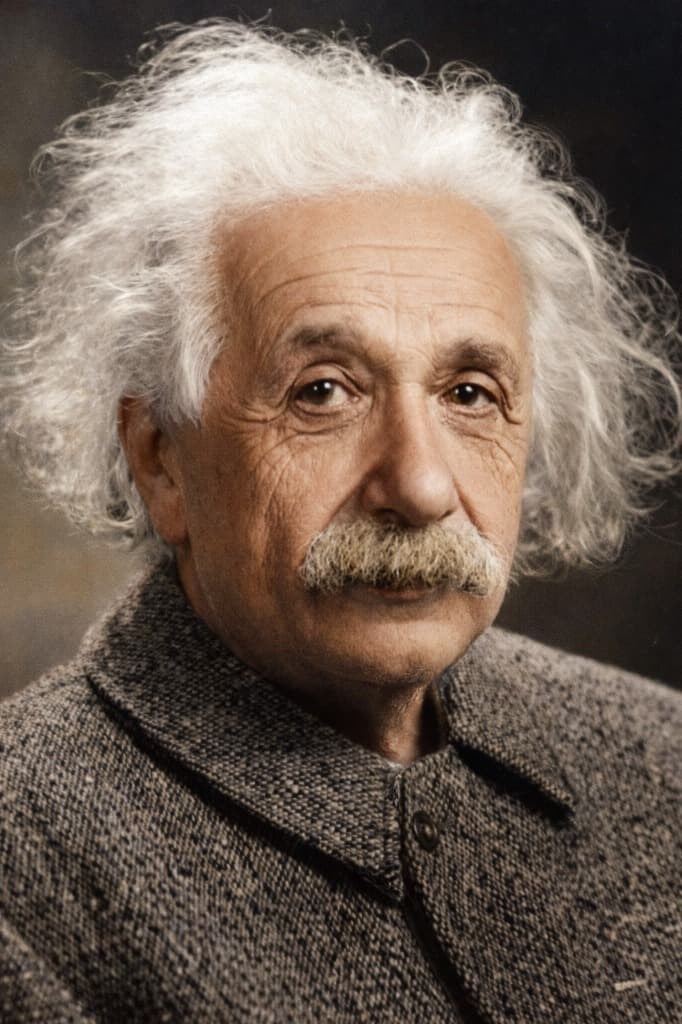
The man who redefined the universe. From patent clerk to Nobel laureate, his legacy goes far beyond E=mc².
Albert Einstein is synonymous with genius. His wild hair and expressive face are instantly recognizable, but his contributions to science are what truly define him. He changed our understanding of space, time, and gravity forever. Here are 10 facts about the man who saw the universe differently.
1. He didn't fail math
A common but comforting myth is that Einstein failed math as a child. This is false. In reality, he was a prodigy. By age 12, he was solving complex algebraic equations, and by 15, he had mastered differential and integral calculus. When shown a newspaper article claiming he had failed math, he laughed and said, "Before I was fifteen I had mastered differential and integral calculus."
2. The Miracle Year (Annus Mirabilis)
In 1905, while working as a lowly patent clerk in Bern, Switzerland, Einstein had arguably the most productive year in scientific history. He published four groundbreaking papers: on the photoelectric effect, Brownian motion, special relativity, and mass-energy equivalence (E=mc²). Any one of these would have been a career-defining achievement; he did them all in one year.
3. He won the Nobel Prize for...
Surprisingly, Einstein did not win the Nobel Prize for his Theory of Relativity. It was considered too controversial and unproven at the time. Instead, he won the 1921 Nobel Prize in Physics for his explanation of the photoelectric effect, which proved that light acts as both a wave and a particle. This work was pivotal in the development of quantum mechanics.
4. His brain was stolen
When Einstein died in 1955, his wishes were to be cremated. However, the pathologist who performed his autopsy, Dr. Thomas Harvey, removed Einstein's brain without the family's permission to study the source of his genius. He kept the brain in jars of formaldehyde for decades, occasionally sending slices to researchers around the world.
5. He was offered the presidency of Israel
In 1952, after the death of Israel's first president, Chaim Weizmann, the Israeli government offered the position to Einstein. He was 73 years old at the time. He politely declined, stating, "I am deeply moved by the offer from our State of Israel, and at once saddened and ashamed that I cannot accept it. All my life I have dealt with objective matters, hence I lack both the natural aptitude and the experience to deal properly with people."
6. He was a refugee
Einstein was a German Jew who rose to fame just as the Nazi party was gaining power. In 1933, while he was visiting the United States, Hitler became Chancellor of Germany. The Nazis raided his cottage, burned his books, and put a bounty on his head. Einstein renounced his German citizenship and never returned, eventually becoming a U.S. citizen in 1940.
7. He married his cousin
Einstein’s personal life was complicated. After divorcing his first wife, Mileva Marić (a brilliant physicist in her own right), he married his cousin, Elsa Löwenthal, in 1919. They were first cousins on their mothers' side and second cousins on their fathers' side. Elsa managed his life and nursed him through illness until her death in 1936.
8. He urged the U.S. to build the atomic bomb
Although he was a pacifist, Einstein signed a famous letter to President Franklin D. Roosevelt in 1939, warning that Nazi Germany might be developing nuclear weapons and urging the U.S. to start its own research. This led to the Manhattan Project. Einstein was later denied security clearance to work on the project due to his pacifist leanings, and he later regretted signing the letter, calling it his "one great mistake."
9. He didn't wear socks
Einstein was famous for his disheveled appearance. He eventually stopped wearing socks altogether, finding them unnecessary and annoying because they would often get holes in them. Whether he was at a formal dinner or sailing on his boat, he would often go sockless, claiming it simplified his life.
10. His last words are lost
Einstein died in Princeton Hospital on April 18, 1955, at the age of 76. In his final moments, he mumbled a few words in German. Unfortunately, the nurse attending to him did not speak German, and his final words were lost to history forever.