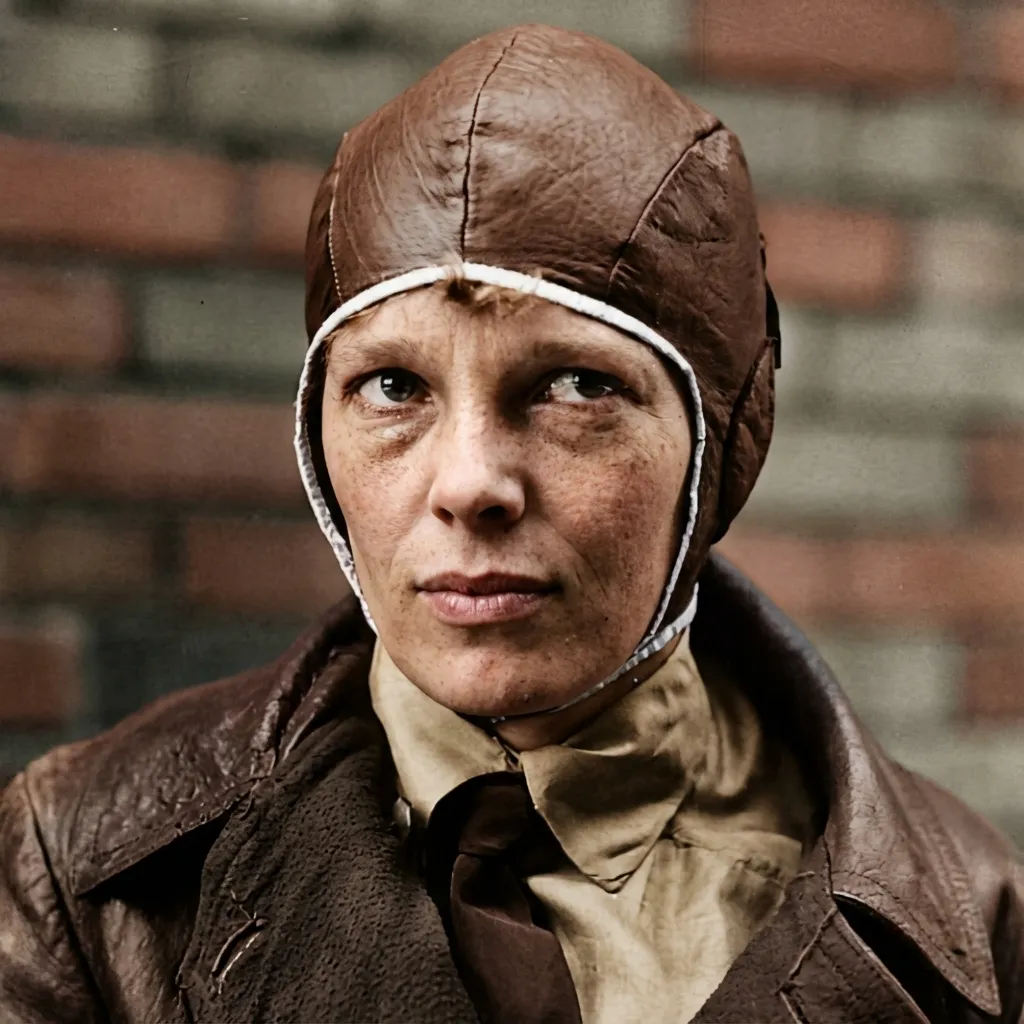
The first woman to fly solo across the Atlantic. Her disappearance remains one of history’s greatest mysteries.
Amelia Earhart was a pioneer who shattered glass ceilings at 10,000 feet. Her courage and charisma made her a global celebrity, but her contributions to aviation went far beyond fame. Here are 10 facts about the woman who refused to be grounded.
1. She wasn't impressed by her first plane
When she was 10 years old, she saw her first airplane at the Iowa State Fair. She was unimpressed, describing it as "a thing of rusty wire and wood and looked not at all interesting." It wasn't until a decade later, when she attended a stunt flying exhibition, that her interest was piqued.
2. "The Canary"
In 1921, she bought her first plane, a secondhand Kinner Airster biplane painted bright yellow. She nicknamed it "The Canary." It wasn't the most reliable aircraft, but in it, she set her first women's altitude record, rising to 14,000 feet.
3. She was a passenger on her first transatlantic flight
Earhart first gained fame in 1928 as the first woman to cross the Atlantic by air. However, she was merely a passenger (or "baggage," as she self-deprecatingly put it) alongside pilot Wilmer Stultz so that the organizers could claim a "first." She vowed then that one day she would fly it herself, solo.
4. The Solo Crossing
True to her word, in 1932—five years to the day after Lindbergh—she took off from Newfoundland in a Lockheed Vega. She battled thick fog, ice on the wings, and mechanical failures. After nearly 15 hours, she landed in a cow pasture in Northern Ireland. A farmhand asked if she'd flown far, and she replied, "From America."
5. She had a fashion line
To fund her expensive flying career, Earhart was an entrepreneur. She launched her own fashion line in 1933, which was sold at Macy's. The clothes were designed for "active living" and "modern women," featuring practical cuts and lengthy shirt tails that wouldn't untuck—innovations inspired by her flight suits.
6. She was a career counselor
In 1935, she joined the faculty at Purdue University as a visiting counselor for women. She didn't teach flying; instead, she counseled female students on careers, encouraging them to enter male-dominated fields like engineering and aviation. Purdue, in turn, helped fund her "flying laboratory," practically buying the Lockheed Electra she would use for her final flight.
7. She was a nurse's aide
During World War I, Earhart visited her sister in Toronto and witnessed the returning wounded soldiers. She decided to leave college to become a nurse's aide at the Spadina Military Hospital. The experience of caring for wounded pilots and hearing their stories deeply affected her and likely sparked her initial respect for aviation.
8. The Ninety-Nines
Earhart was instrumental in forming an organization for female pilots in 1929. They named it "The Ninety-Nines" because that was the number of charter members. Earhart served as the first president. The organization still exists today, supporting women in aviation.
9. Her unique marriage contract
When she married publisher George Putnam in 1931, she was hesitant about losing her independence. She famously wrote him a letter on their wedding day, stating, "I want you to understand I shall not hold you to any midaevil [sic] code of faithfulness to me nor shall I consider myself bound to you similarly." She retained her own name and referred to the marriage as a "partnership" with "dual control."
10. The Disappearance
On July 2, 1937, Earhart and navigator Fred Noonan disappeared over the Pacific Ocean while attempting to circumnavigate the globe. Despite one of the most extensive and expensive search and rescue missions in U.S. Navy history, no trace of the plane was ever found. Theories range from crashing and sinking to landing on a remote island (Nikumaroro) and living as castaways, but the mystery remains unsolved.