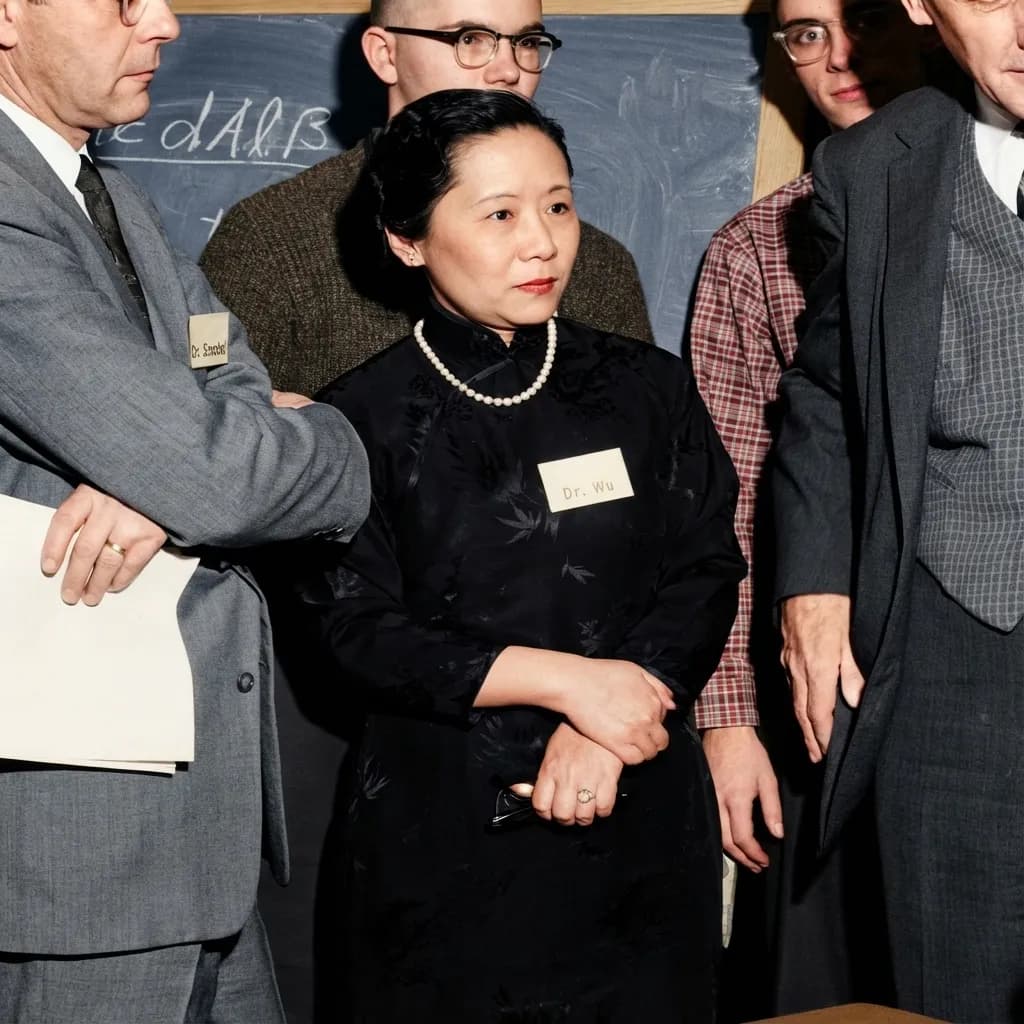
She overturned a law of nature. A brilliant experimental physicist who changed how we understand the universe.
Chien-Shiung Wu was known as the "Chinese Marie Curie." Her experiments were so precise and elegant that she was the go-to person when a theory needed to be proven—or disproven. She played a key role in the Manhattan Project and revolutionized particle physics.
1. Her name means "Courageous Hero"
Born in China in 1912, her father was an advocate for women's education. He named her Chien-Shiung, which means "Courageous Hero," a name usually given to boys. She lived up to it.
2. She worked on the Manhattan Project
Wu came to the U.S. to study and was recruited for the Manhattan Project. She helped develop the process for separating uranium isotopes (U-235 from U-238) by gaseous diffusion. Her work was critical to the fuel production for the atomic bomb.
3. The Wu Experiment
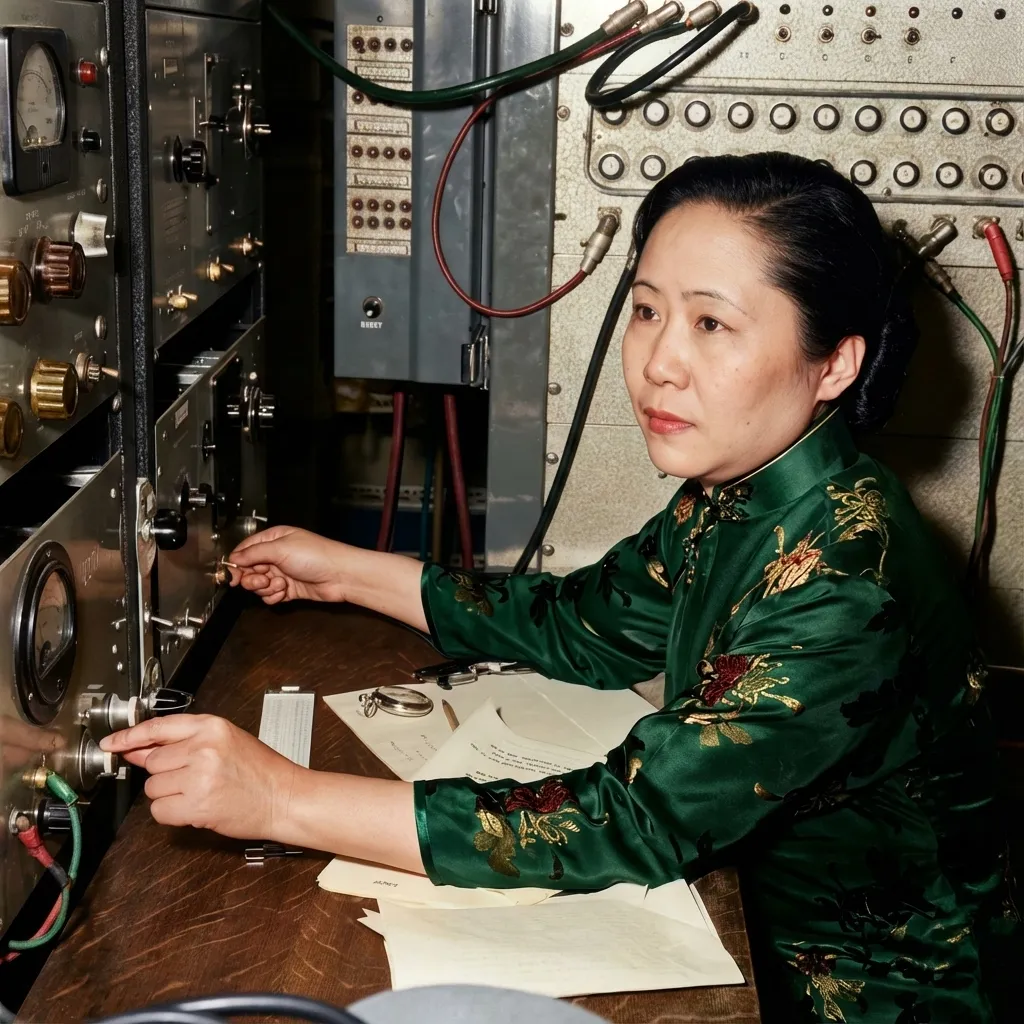
Her most famous work came in 1956. Theorists Lee and Yang suspected that a fundamental law of physics—which assumed nature behaves the same way in a mirror—might be wrong. They needed someone to prove it. Wu designed a brilliant, super-cooled experiment to find the truth.
4. She disproved a fundamental law
Wu's experiment proved them right. She showed that in the nuclear world, nature does distinguish between left and right. This discovery shattered a fundamental belief that scientists had held as absolute truth for decades.
5. The Nobel Snub
Lee and Yang were awarded the Nobel Prize in Physics in 1957 for the theory. Wu, who did the experiment that actually proved it, was excluded. It is considered one of the biggest snubs in Nobel history.
6. First Female President of the APS
In 1975, she broke another glass ceiling, becoming the first woman to be elected president of the American Physical Society, the most prestigious organization of physicists in the world.
7. An asteroid is named after her
In 1990, the asteroid "2752 Wu Chien-Shiung" was named in her honor, placing her name among the stars she helped us understand.
8. She advocated for women in science
Wu was famously quoted: "I wonder whether the tiny atoms and nuclei, or the mathematical symbols, or the DNA molecules have any preference for either masculine or feminine treatment." She fought against gender bias her entire career.
9. The Wolf Prize
While she didn't get the Nobel, she was the inaugural winner of the Wolf Prize in Physics in 1978, an award often considered second only to the Nobel.
10. She verified quantum entanglement
Before her parity work, she performed a crucial experiment with light particles (photons). Her results confirmed key theories in quantum mechanics, laying the groundwork for what we now call quantum entanglement—the strange connection between particles that makes quantum computing possible.